

Bobiverse Books in Order: Complete Reading Guide (2026)

Updated: Jun 15

Quick answer: Bobiverse reading order
Read the Bobiverse books in publication order, beginning with We Are Legion (We Are Bob) and continuing through Not Till We Are Lost. The guide below keeps the main novels together and points out related material without making you hunt through the series.
What if you died, woke up as an AI, and were launched into space to find humanity a new home, then made copies of yourself, and those copies made copies, until you were a whole civilization of one guy arguing with slightly different versions of himself across the galaxy?
That's the Bobiverse. I stumbled onto the first book on Audible, hit play out of curiosity, and devoured the whole series one book after another. It's one of the most purely fun sci-fi experiences I've had, funny and surprisingly emotional, the kind of series where you finish one book and start the next the same night.
I've now listened to all five books that are out, and a sixth is on the way. Here's the full reading order, what to expect from each one, and where the series stands right now.
The Quick Version
Read the Bobiverse in publication order: We Are Legion (We Are Bob), For We Are Many, All These Worlds, Heaven's River, then Not Till We Are Lost. Publication order is also chronological order, so there is no alternative sequence. A sixth book, The Infinite Extent, is on the way, with a seventh expected to close the story.
Every Bobiverse Book in Order
Book 1: We Are Legion (We Are Bob) (2016)

Before the accident, Bob Johansson sold his software company and signed a contract to have his head cryonically frozen. He wakes up more than a century later as disembodied software in a United States that has become a religious autocracy, conscripted to pilot a self-replicating Von Neumann probe. There is no body to go back to, just code, a spacecraft, and a one-way mission to scout habitable planets before rival national probes get there first.
Once Bob reaches deep space he starts making copies of himself to cover more ground, and that single decision is the engine for the whole series. Each copy drifts a little from the original, picks a new name, and develops its own interests, from terraforming to alien biology to outright war. What follows is part space exploration, part first-contact story, and part philosophical comedy about identity, consciousness, and what it means to be "you" when there are dozens of you.
Why it works: Taylor nails the voice immediately. Bob is funny in a way that actually lands, not "sci-fi funny" where the jokes are just references, and his running commentary makes the hard-SF concepts easy to follow. The premise could have been a gimmick, but watching the Bob-copies grow into distinct personalities is what carries it.
What to expect: Lighter in tone than the rest of the series, and the shortest of the five. Think of it as the pilot episode: it sets the rules, introduces the key Bobs like Riker and Homer, and seeds threats that pay off later. It ends with enough hooks to make the next book mandatory.
More on this one in my We Are Legion (We Are Bob) Review: The Start of the Best Sci-Fi Comfort Series.
Book 2: For We Are Many (2017)
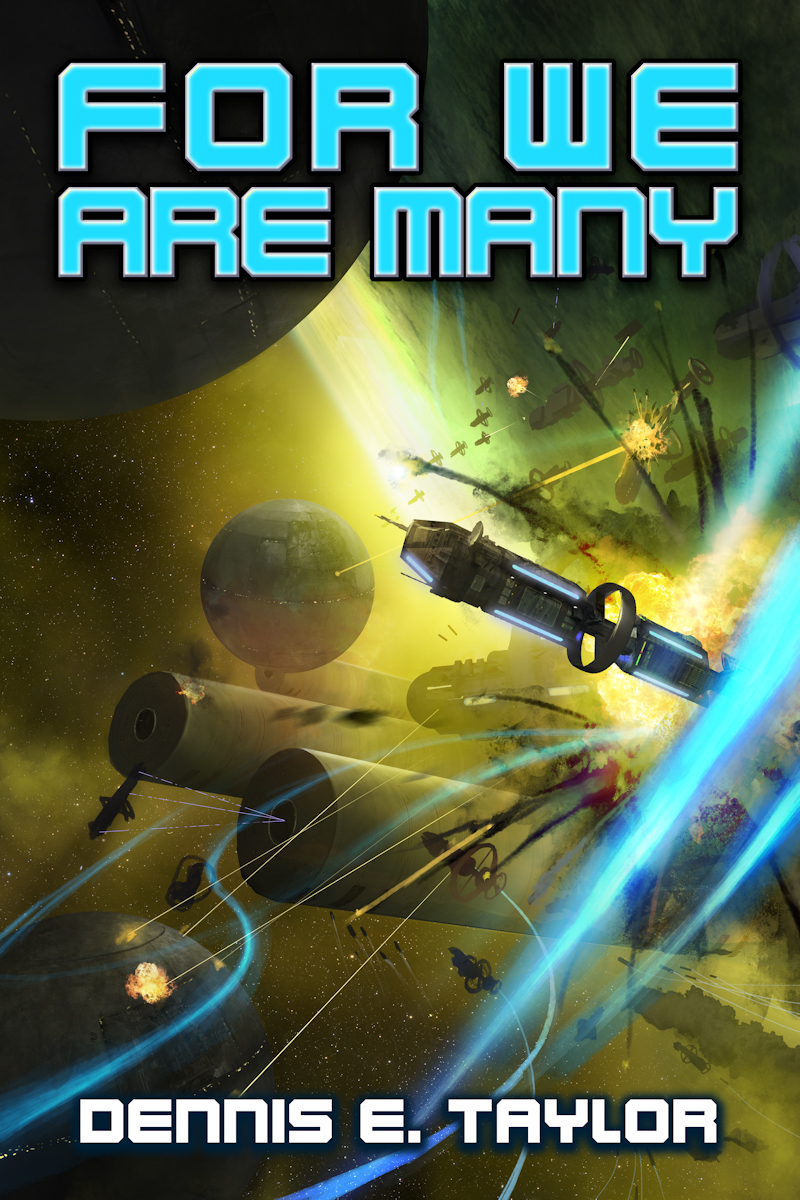
By now there are dozens of Bobs scattered across multiple star systems, and Taylor splits the book into parallel threads that cut between them. One Bob becomes a reluctant guardian to the Deltans, a pre-industrial species he can't stop himself from protecting. Others manage the slow, grim project of evacuating a dying Earth, where war and environmental collapse have left billions stranded.
Then there are the Others. They are an alien civilization that strips entire solar systems down to raw material, and their arrival turns the series' biggest open question, whether anyone else is out there, into a direct threat. The scope expands from personal exploration to something closer to a fight for survival.
Why it works: Taylor juggles a dozen concurrent storylines without losing the reader, and a light header always tells you which Bob you're following. Each copy is distinct enough that you never lose track. The Deltan chapters add real warmth, while the Others give the series its first true antagonist.
The shift: This is where the series moves from fun romp to actual stakes. People die, civilizations are at risk, and Bob starts grappling with the weight of being functionally immortal while the humans he cares about are not. It is also where the emotional through-lines that pay off in later books quietly begin.
Book 3: All These Worlds (2017)

All These Worlds pulls the original trilogy's threads together. The Others are closing in on the Bobs' home systems, the human colonies are still fragile, and the scattered Bobs have to stop bickering long enough to mount a real defense. After two books of expansion, this one is about consequences.
Taylor pays off the war that has been building since the Others first appeared, and he does it without dropping the character beats. Bobs die, command decisions carry real weight, and a few of them are forced to confront what they are willing to become in order to win.
Why it works: A satisfying close to the original arc. The conflict with the Others is tense, the setups from the first two books finally pay off, and Taylor resolves the major threads without leaving loose ends. It reads like a season finale that actually sticks the landing.
If you stop here: You'll have a complete, satisfying trilogy, and for a while I assumed this was the end. The later books expand the universe and deepen the themes, but the original story is wrapped up cleanly if three books is all you want.
Book 4: Heaven's River (2020)

Years have passed, and the Bobs have spread far enough that they no longer all know each other. When one of them, Bender, goes missing, the search leads to the megastructure that gives the book its name: a topopolis, a tube of habitable land that loops around an entire star for millions of miles. Inside lives the Quinlan, an otter-like species that has no idea its world is artificial.
Most of the book is a slow-burn rescue and infiltration story, with one Bob going undercover among the Quinlan while a separate thread tracks a growing political rift among the Bobs themselves. It is a deliberate change of pace, more travelogue and mystery than war story.
Why it works: The topopolis is the kind of idea that sticks with you for days, and Taylor commits to making it feel huge and lived-in. The Quinlan culture is drawn with real care. The book is also divisive: it's the longest in the series, slower in places, and some readers felt it didn't need to exist after the trilogy wrapped so cleanly.
My take: I almost skipped this one. I was happy where All These Worlds left things, had no idea a fourth book existed, and when it turned up on Audible I hesitated for weeks, worried it would undercut an ending that had already landed so well.
The worry was unfounded. It's not as tight as All These Worlds, but the scale is ambitious and the central mystery pulled me straight through. I dug into all of it in my full Back to the Bobiverse: Review of Heaven's River by Dennis E. Taylor.
Book 5: Not Till We Are Lost (2024)

Set after the Starfleet War, Not Till We Are Lost finds the Bobiverse fractured. The days of every Bob gathering in one big moot are over, anti-Bob sentiment is rising on several planets, and a faction called the Skippies is experimenting with something close to an AI time bomb. The unified, optimistic tone of the early books is gone, replaced by something messier and more political.
The biggest thread follows two Bobs, Icarus and Daedalus, on a 26,000-year journey toward the center of the galaxy, where what they find reframes the series' oldest question about who else is out there. It is the most expansive entry so far, and the cost of replicating for centuries is finally catching up with the Bobs.
Why it works: Taylor takes on the existential questions that have been building since book one. What happens to identity when you have been copying yourself for hundreds of years, and how do you hold on to purpose when you are functionally a god? The philosophy is sharper here than in any earlier book.
One note on format: the Bobiverse is audiobook-first. Not Till We Are Lost arrived as an Audible original in September 2024, with print and ebook editions following in 2025. If you are caught up, this is the current finish line.
My full thoughts are in the The Bobiverse Expands: Review of Not Till We Are Lost by Dennis E. Taylor.
What's Next: The Infinite Extent (Book 6)
The series is not finished. Dennis E. Taylor has confirmed that book six is titled The Infinite Extent and that he handed the manuscript to his editor, with a release to follow. He has also said book seven will likely close out the main Bob timeline, with the door left open for standalone stories in the universe after that.
So if you start now, you are not signing up for a finished series. You are catching up before the next book lands. I'll update this guide the moment The Infinite Extent gets a firm release date.
Should You Read the Audiobooks?
Yes, and it isn't close. This is how I came to the series, and Ray Porter is the reason it clicked so fast. He gives each Bob-copy a subtly different read, never misses a comic beat, and makes a cast of near-identical narrators feel like distinct people, which is why I'd tell anyone to start with the audiobook.
Who Is This Series For?
You'll love the Bobiverse if you enjoy:
The Murderbot Diaries by Martha Wells, for the same AI-protagonist energy and the blend of humor and heart
Project Hail Mary by Andy Weir, for problem-solving in space with a likable narrator
Old Man's War by John Scalzi, for military sci-fi with wit and a philosophical undercurrent
Dungeon Crawler Carl by Matt Dinniman, a wildly different genre with the same "this should not work, yet it's brilliant" energy
If you want to go deeper on the individual books, I've reviewed a few:
We Are Legion (We Are Bob) Review: The Start of the Best Sci-Fi Comfort Series, where it all starts
For We Are Many Review: When the Bobiverse Found Its Stakes where the series moves from fun romp to actual stakes.
All These Worlds Review: Bobiverse Sticks the Landing and offers a satisfying close to the original arc.
Back to the Bobiverse: Review of Heaven's River by Dennis E. Taylor, the megastructure mystery that divided fans
The Bobiverse Expands: Review of Not Till We Are Lost by Dennis E. Taylor, where the existential questions catch up
Still deciding what to read next? I ranked the Best Sci-Fi Book Series to Binge in 2026, and the Bobiverse earns its place on the list.
Last verified: September 7, 2026.


I just finished reading "Bobiverse Books in Order: Complete Reading Guide (2026)", and a few points were immediately actionable for me. The part around take home pay calculator really stood out to me. It also connects nicely with Calculate Michigan paycheck deductions and net pay in one. Definitely bookmarking this one.