

The Tainted Cup Review: More Than Fantasy Sherlock

Rating: 4.5/5 ⭐️
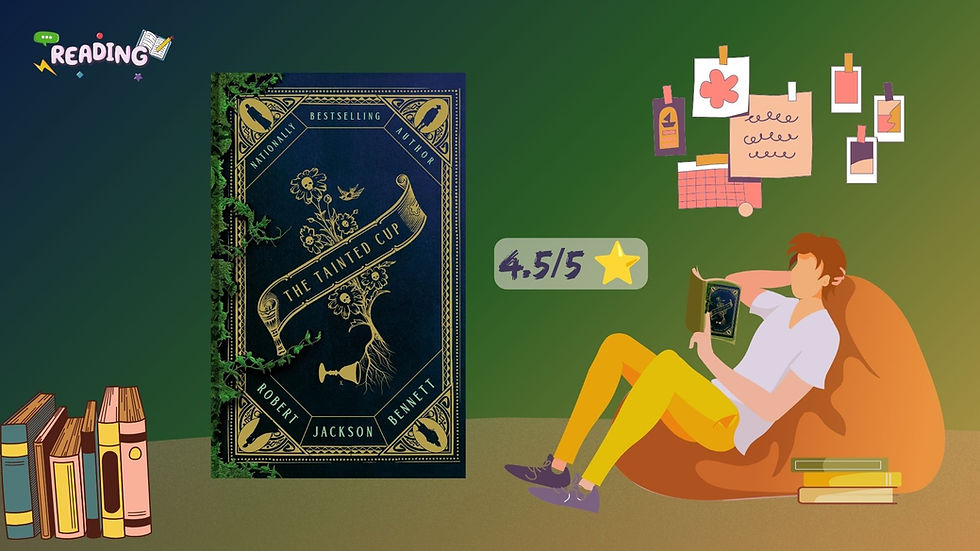
I rated The Tainted Cup 4.5 out of 5. Since finishing it, I have not spent much time thinking about the murder or trying to reconstruct Ana Dolabra’s deductions.
I keep thinking about the walls.
The most common shorthand for Robert Jackson Bennett’s novel is Sherlock Holmes and Watson in a fantasy world. I understand the comparison. Ana is a brilliant, eccentric investigator who can make startling deductions from the information placed before her. Dinios Kol is the man she sends into the world to interview people, inspect crime scenes and bring the details back.
That resemblance exists. I just do not think it captures the part of the book that stays with you.
Din is not simply the Watson
Din does much of the investigation on Ana’s behalf, but he is not only the ordinary observer standing beside a genius. He is an engraver, someone whose body has been altered so that he can retain his experiences with extraordinary precision.
He can return from an investigation and give Ana the details she needs. Conversations, rooms and observations become records she can examine through him.
That ability is useful to the mystery, but it also reveals something much larger about the setting. Din’s memory is not an isolated magical gift. It belongs to an empire that modifies human bodies for particular forms of work.
People can be altered for strength, endurance, sharper senses or other specialised functions. Bodies have become part of the empire’s technology. The detective story introduces the idea through Din, then gradually reveals how deeply this science runs through the society around him.
Calling Din “the Watson” flattens that. His role in the investigation is familiar, but the reason he can perform it belongs entirely to Bennett’s world.
The wet season changes the scale of the story
Beyond the murder sits a threat large enough to reshape the empire.
Leviathans emerge from the sea during the wet season. Massive walls stand between them and the people living further inland. A breach is not a distant possibility from an old legend. It is a recurring danger around which the empire has organised its defences, labour and science.
The moment that scale became real for me was the leviathan attack. Coloured signals are fired into the sky, panic spreads and the murder investigation suddenly feels very small beside the threat bearing down on the walls. The scene turns the leviathans from background worldbuilding into something immediate.
The leviathans are not merely large monsters waiting for an action sequence either. Their presence reaches into the plants, the altered bodies and the strange biological processes found throughout the book. The empire studies them, fears them and derives new forms of science from them.
Its greatest threat is also one of the foundations of its power.
That relationship left me with far more questions than the murder did. How much does the empire truly understand about the leviathans? What happens when a civilisation becomes dependent on material taken from the creatures it is trying to keep outside its walls? How much of its social order exists because the wet season gives that order a permanent justification?
The book does not stop to answer everything. I am glad it does not.
The mystery teaches you how the world works
The detective structure still matters. It gives Bennett a way to reveal the setting without pausing for long explanations.
Din enters a location because he is following a lead. He notices an alteration because it may be evidence. Ana asks about a detail because it does not fit. While they work through the case, the reader learns how plants, bodies, institutions and technology operate in this world.
The science is therefore not decoration placed around a conventional murder mystery. It affects what can happen, what counts as evidence and what kinds of crimes are possible.
The Sherlock comparison describes the arrangement between two characters, but not the experience of reading the novel. I was not turning the pages solely to see whether Ana could identify the killer. I wanted to understand the empire outside her room: the alterations, the leviathans and what their arrival every wet season had done to this civilisation.
My verdict
I gave The Tainted Cup 4.5 out of 5 because the mystery provides a strong route through an even stronger setting.
Ana’s deductions are entertaining, and her arrangement with Din gives the investigation its shape. The familiar detective pairing helps us enter the story. Once inside, though, Bennett’s world takes over.
What stays with me is the image of those coloured signals above the walls and the panic below them, warning that something vast is coming from the sea.
Sherlock and Watson may help explain the premise. They are not the reason I want to return.


Comments