

The Villains Own One Piece Season 2 (And That's a Good Thing)
- Vinit Nair
- Mar 26
- 5 min read

Rating: 8/10 ⭐️

Season 1 of Netflix's One Piece was about assembling the crew. Every episode gave a Straw Hat their moment: the backstory, the motivation, the reason to sail.
Season 2 does the same thing, except not for the heroes. This is the villains' season, and it's better for it.
I finished all eight episodes in a few days and came out the other side rating it an eight out of 10. But the number isn't the interesting part. What's interesting is that I spent most of the season thinking about the bad guys.
Season 1 Was the Straw Hats' Audition. Season 2 Is Baroque Works'.

Think about how Season 1 was structured. Every major arc existed to introduce a crew member.
Zoro gets his backstory. Nami gets hers. Usopp, Sanji, each one gets their episode, their emotional hook, their reason for joining.
By the time the crew sets sail together, you know exactly who these people are.
Season 2 doesn't need to do that anymore. The Straw Hats are assembled. They're a unit.
So the show does something clever with all that freed-up character-building energy: it points it at the villains.
From the moment the crew enters the Grand Line and ends up inside a whale (yes, a whale), Baroque Works starts showing up. And they don't just show up as obstacles. They show up as characters.
They get introductions. They get personality. They get screen time that, in a different season, would have gone to the heroes.
The Straw Hats are still here, obviously. They're sailing, fighting, reacting. But they're operating on momentum from Season 1.
This season belongs to the rogues' gallery.
David Dastmalchian's Mr. 3 Is the Proof of Concept

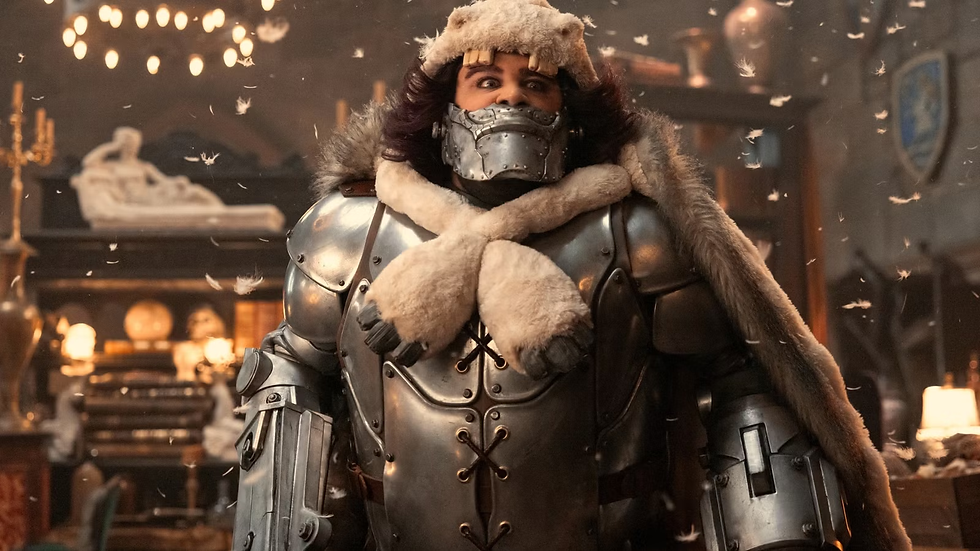
If you want to understand what I mean by "the villains own this season," watch David Dastmalchian as Mr. 3.
This is a guy who played Polka-Dot Man in The Suicide Squad and Piter de Vries in Dune. He has a very specific skill: he can walk into a scene dripping with theatrical menace and make you unable to look away. He brings that same unhinged commitment to Mr. 3, and the show gives him the room to do it.
Every scene he's in, he steals. Not in the way a flashy cameo steals a scene, but in the way a character actor with real craft can make a wax-obsessed villain feel like the most dangerous person in the room.
The show treats Mr. 3 like a main character for the stretch he's in, and that's a choice you don't see in most adaptations. Usually the villain shows up, monologues, fights, and leaves. Here, the villains get the same care the Straw Hats got last season.
And it's not just Mr. 3. The Baroque Works agents across the board get proper introductions. The show is building an antagonist roster with the same patience it built its hero roster.
The Trade-Off: Pacing That Moves Fast and an Ending That Moves Too Fast
The villain-heavy structure comes with a cost, and I want to be honest about it.
The season covers a lot of ground. The crew stops at Loguetown, the birthplace of the Great Pirate Era. They cross into the Grand Line.
They end up inside a whale named Laboon. They get entangled with Baroque Works. They land on Little Garden, a prehistoric island with giants.
Then Nami falls ill, and the story shifts to Drum Island.
That's a lot of locations, a lot of new characters, and a lot of plot for eight episodes. The pacing moves quickly. Not always in a bad way, but you feel it.
Where I felt it most was the finale. King Wapol had eaten a Devil Fruit, his army had gotten a serious upgrade, and it seemed like the Straw Hats were on the verge of losing. Real tension.
And then a punch through a window apparently kills Wapol, the mutant soldiers revert back to normal, and it's over.
It felt abrupt. Convenient. After a season that took its time building up its villains, the final one got taken out like the show ran out of episodes.
A quick look at YouTube confirmed that the anime handles Wapol's defeat with considerably more weight. The live-action version feels like it needed another five minutes to earn that ending.
Chopper's Backstory Earns the Heart the Villains Can't Provide

Here's where the season is smart about its own structure.
For most of the runtime, the emotional register is adventure and spectacle. Baroque Works schemes. The Straw Hats fight.
Locations change. It's fun, but it's not hitting you in the chest.
Then the story shifts to Drum Island, and suddenly you're watching a completely different kind of story. Chopper's backstory, the newest member and future doctor of the Straw Hat crew, is the emotional anchor of the entire season. It's a story about loss, about belonging, about finding the people who accept you for what you are.
The season needed this. Without Drum Island, Season 2 would be all spectacle and villainy with no soul to hold it together. Chopper's arc is what makes the whole thing land.
It earns its place as the emotional climax because the show was disciplined enough to hold it back until the right moment.
The Production That Lets the Villains Land

None of the villain-heavy storytelling works if the show can't back it up visually. Season 2 can.
The personalised title cards for each episode are a small detail, but they signal a show that knows its own identity. Each card feels specific to the episode's tone and setting, not a template with swapped text.
The action sequences are a clear step up from Season 1. The effects work, especially on the Grand Line and Little Garden, is top notch. The dinosaurs, the giants Dorry and Brogy, the Devil Fruit powers in action: all of it looks like a show that got a bigger budget and knew exactly how to spend it.
And that matters for the villain thesis specifically. Mr. 3's wax powers, Wapol's transformations, the Baroque Works agents in full flight. These need the VFX to feel convincing or the whole structure falls apart.
The show has a confidence now that Season 1 was still building towards. It's not apologising for being cartoony or fantastical. It leans in, and the result is villains who feel like real threats rather than rubber-suit obstacles.
Looking Forward

Season 2 works because it trusts its villains to carry the weight. It's not a perfect season. The pacing runs hot, and the Wapol resolution is the one moment where the structure buckles.
But the overall experience is a fun ride with more personality, more ambition, and more confidence than most shows manage in their second outing.
Season 3 has a high bar to clear. I'm looking forward to it.
Rating: 8/10


Comments