

I Tested 13 AI Tools Over 3 Years. Here's What Survived.

The winners weren't the best AI. They were the ones already where I work.

I was paying for three AI subscriptions I hadn't opened in weeks.
Not because AI had stopped being useful. Because somewhere between ChatGPT's pivot toward coders, Perplexity's loud promises about killing Google, and an AI browser that looked beautiful but couldn't justify another layer of memory, my existing apps had quietly gotten smarter than all of them.
This is the story of 13 tools, three years, and what I actually have open right now.
Where It Started
I work as a growth marketer and writer. I run consulting work, manage clients, write across multiple platforms, and track everything in Notion. When AI started getting actually useful, I went all in.
The logic seemed sound: more tools, more capability. Some I paid for and used for months. Others lasted a week.
The list: Claude, ChatGPT, Notion AI, Microsoft Copilot, Gemini, Perplexity, Grammarly, Google Docs, Google Slides, Canva, OpenAI's Atlas browser, Arc, Dia, Google NotebookLM, and Meta AI. Fifteen tools if you count the ones I didn't put in the headline.
The Casualties: Tools That Lost the Plot
ChatGPT was the first AI I actually paid for. ChatGPT Plus from the beginning, when it still felt like a genuine edge. For a long time, it was the default: the thing you opened when you needed to think through something or draft something fast.
Then something shifted around the 5.x releases. The product started bending toward developers: coding, agentic tasks, operator use cases. Useful for that audience, but not for mine.
For a marketer and writer who needed a sharp thinking partner for content work, the changes made it feel less like the tool had improved and more like it had found a different user.
Perplexity had a great story. The scrappy challenger calling out Google's bloated search results. I used it for research, especially when I wanted citations alongside answers. The problem: Google actually fixed its search. Once Gemini arrived properly in Google Search, the primary reason to go to Perplexity collapsed. It still does its thing. There just isn't much reason to go there when the answer is already in the tab you have open.
Grammarly ended fast. The moment Gmail learned to write and Google Docs started suggesting full sentences, the standalone grammar layer became redundant. I didn't consciously cancel it. I just noticed I hadn't used it in two months.
Microsoft Copilot looks extraordinary in demos. Microsoft has put considerable effort into making it look like the future of work. In actual daily use, it disappoints in ways that are hard to articulate precisely but easy to feel: the suggestions miss, the integration feels bolted on, the context window forgets things it should remember. The demo and the product are two different products.
Meta AI I tested and walked away from quickly. My skepticism about what Meta does with data is not small, and the product didn't give me enough reason to override that concern. Some tools ask for trust and give you something worth trusting in return. This wasn't one of them.
The Browser Wars Nobody Is Writing About
This is where the story gets interesting.
Arc was genuinely one of the most innovative browsers I've used. The Browser Company built something that thought differently about how tabs, windows, and spaces should work. Chrome borrowed from it. Dozens of other browsers borrowed from it. Then The Browser Company killed it to build Dia, and a product that had been quietly influencing the whole industry was gone.
Dia is beautiful. Polished in a way very few browser products are. But the AI is where it falls apart for my actual usage. I'm already paying for Claude and Gemini. My data, my context, my history lives in those two ecosystems. Building a third layer of AI memory inside a browser I'd have to pay yet another subscription for, from a model that can't compete with either at the level I need, just doesn't make sense.
OpenAI's Atlas had promise. AI-native browsing with ChatGPT built into the sidebar for instant context on any page. The problem was simpler than I expected: as I moved away from ChatGPT toward Gemini and Claude, my reasons to use Atlas went with it.
A browser that lives or dies by one AI's ecosystem is a fragile bet. OpenAI has shown it will shut down products that don't fit the roadmap: Sora, the video generation app launched just months earlier, is being discontinued on April 26.
Chrome with Gemini won by doing almost nothing flashy. I already use Chrome. Gemini is already in my subscription.
When Google added Gemini to Chrome, Gmail, YouTube, and Docs, it didn't ask me to go somewhere new. It showed up where I already was: YouTube summarizes videos, Gmail extracts key points from long threads, Docs rewrites paragraphs without a tab switch. None of it required a new habit.
That's not a revolution. It's just useful, available, and already paid for.
The Comeback Stories
Gemini was unusable for me in the 2.5 era. I tried it, found it lacking, and moved on. Gemini 3 Pro changed that. It's now co-pilot level alongside Claude, and the deep integration across Google's product suite means it's often the first thing I reach for because it's already there.
NotebookLM I used heavily for a period: research summaries, audio generation from long documents, sense-making across multiple sources. I use it less now because Notion AI handles a lot of what I used it for. It's benched, not cut. There are specific research use cases where it still earns its place.
What's Actually in the Stack
Claude is the thinking partner. Best for drafting, reasoning, and talking through a complex problem from multiple angles. The usage limits are the one real frustration. The quality of output inside those limits is the best I've found.
Gemini is the ambient layer. It lives in Chrome, in Gmail, in YouTube, in Docs. I don't always open it intentionally. It's just there when I need it, working with context it already has.
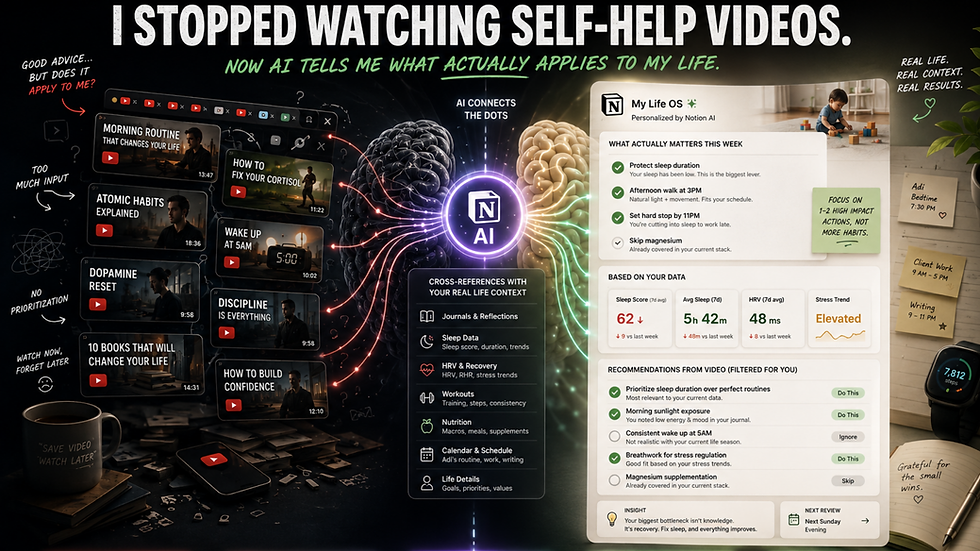
Notion AI 3.0 is the biggest shift on this list. For years, Notion AI was a bad joke. It couldn't read my own pages properly, gave answers that missed obvious context, and failed in ways that were almost impressive.
The 3.0 release fixed that. Now it can manipulate pages, build databases, take meeting notes, and work with the full context of what's already in my workspace.
Most of my daily work happens inside Notion. Having AI that actually understands that workspace is more valuable than any standalone tool I tested.
Canva stays because it's the best tool for making visuals for my work and my clients. The AI isn't leading the product yet. The product is good enough that it doesn't need to be.
The Actual Lesson
The tools that survived didn't win on raw AI performance. They won because they stopped asking me to go somewhere new.
Claude meets me in a chat. Gemini meets me in my browser. Notion AI meets me in my workspace: none of them asked me to rebuild a habit or justify a new subscription for a problem I'd already solved.
The graveyard is full of products that needed me on their terms. The survivors understood that the hardest thing to ask of a busy person isn't money. It's attention.
Before you add another AI subscription, check whether the tools you already pay for have quietly solved the problem. Most of them have. You probably just haven't checked lately.


Comments