

I Quit Self-Help Videos. Notion AI Watches Them For Me.

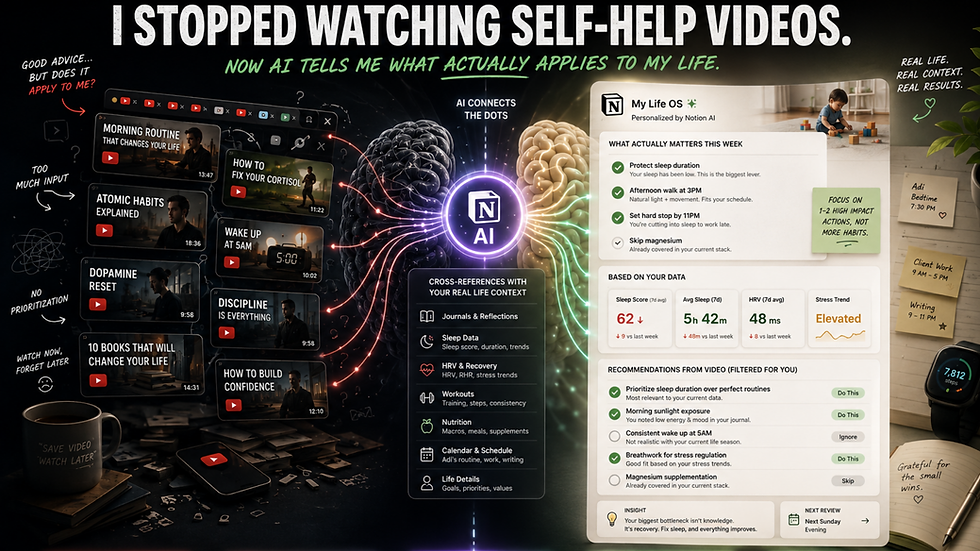
There was a version of me that watched a 20-minute YouTube video on stoic philosophy at 11 PM, felt enlightened, and then did nothing about it. That version of me had free time. Then my son started walking.
Was I Learning or Just Watching?
Before Adi, I had a routine. Not a productive one, but it felt like one.
I'd queue up videos with titles like "10 books to read in your 30s," "14 books that will change your life," "How to think like a stoic."
I'd watch them back to back, sometimes two or three in a sitting, nodding along like I was absorbing wisdom through osmosis.
I wasn't. I was consuming content about improvement while doing nothing to improve.
The videos gave me the feeling of progress without any of the friction that actual progress requires.
A 15-minute breakdown of James Clear's Atomic Habits feels productive. Writing down one habit you want to build and tracking it for a week feels like work. I picked the video every time.
The thing is, I still love watching videos. That kind of watching isn't about extracting value. It's about unwinding.
The problem was never the watching itself. It was pretending that watching self-help content counted as doing something about it.
The Time Squeeze
Then Adi arrived. He's almost two now, and "free time" is a concept I remember fondly, like affordable rent or sleeping past 7 AM.
The 20-minute video window closed. Not because I chose to stop, but because a toddler doesn't care that you're 12 minutes into a Huberman episode about dopamine regulation.
I still wanted the information. I couldn't sit through the delivery method anymore. So I went looking for shortcuts.
YouTube AI Summaries: The Half-Solution
YouTube rolled out AI-generated video summaries, and for a while, they felt like the answer. Two minutes of reading instead of 20 minutes of watching.
I could skim the key points of a video while Adi played with blocks, get the gist, and move on.
For certain types of videos, this works perfectly. A tech review gives you specs, verdict, and price; a news explainer gives you the facts.
Straightforward content where the information IS the value translates well to a summary.
But self-help and productivity content didn't translate. I'd read a summary of a video about morning routines and think, "Okay, so wake up at 5 AM, meditate, cold shower, journal."
Except I have a toddler who wakes up at 6:30 on a good day and 5:15 on a bad one. The "wake up before everyone else" advice assumes a life structure I don't have.
The summary gave me the information. It didn't give me the interpretation.
The Missing Layer
Every video summarizer, AI summary tool, and "key takeaways" feature out there has the same blind spot. They extract what the video says. They know nothing about who's reading the summary.
A summary of "how to reduce cortisol" will tell you: get more sleep, cut caffeine after 2 PM, do breathwork, reduce screen time before bed. All correct.
But it doesn't know that my sleep score last night was 62. It doesn't know I already track HRV and resting heart rate daily and that both have been trending down this week.
My protein was at 160g yesterday. My sleep was five and a half hours. The summary has no idea I've been journaling about feeling stretched thin between client work and the blog.
Without that context, the advice is generic. With it, the advice becomes specific: "Your HRV has dropped eight points this week and your sleep has been under six hours three nights running. The cortisol video's breathwork suggestion is worth trying, but the bigger lever for you right now is probably sleep duration, not a new habit."
That's not a summary anymore. That's my health data arguing with a YouTube video and telling me what to actually do about it.
The Workflow That Actually Changed Things
I stumbled into this by accident. I use Notion for everything. Journals. Health dashboard with daily sleep scores, HRV, resting heart rate, food logs with macros, workout plans.
Client notes, reading lists, daily logs. It's less an app and more an external brain at this point.
Notion AI can see all of it. And I've built custom skills: instruction pages that tell the AI how to interpret my data for specific use cases.
One for health coaching. One for life coaching. They map incoming information against my actual situation.
So the workflow became:
Find a video I want to learn from but can't sit through
Drop the YouTube link into a Notion page
Ask Notion AI to pull out the key takeaways
Then the real step: ask it, "Based on my health data, journals, and current routines, which of these takeaways actually apply to me? What should I implement this week?"
Notion AI isn't summarizing the video. It's cross-referencing the video's advice against months of my own data.
What This Looks Like in Practice
Last week I dropped in a video about sleep optimization. The usual suspects: consistent wake time, cold room, no screens before bed, magnesium supplementation, morning sunlight.
A YouTube AI summary would give you those five bullet points. Useful if you've never thought about sleep before. Not useful if you've been tracking it for months.
It noted that my sleep scores had been declining not because of consistency (my wake time is pretty locked in, thanks to Adi's schedule) but because my time-in-bed had shrunk.
I'd been staying up later to write after Adi goes to sleep, cutting into hours. The video's advice about consistent wake times was already handled. The real takeaway for me was about protecting the other end: setting a hard stop on work by 11 PM.
It also flagged that my magnesium intake was already covered through my supplement stack, so that recommendation was a skip.
And it connected the "morning sunlight" advice to something I'd noted in my journal: feeling groggy on days I went straight to my desk without stepping outside.
Same video. Completely different action items than a generic summary would produce.
One Actionable Change From a Video I Never Watched
I'm not going to pretend this is the only way to get value from videos.
Plenty of people watch a productivity video, pick one idea, and run with it. That works if you have the time and the self-awareness to filter advice through your own circumstances.
I don't have the time. And the filtering is the hard part.
I tried a cortisol-reduction video last month. The summary gave me seven recommendations. Notion AI crossed them against my health dashboard and told me I was already doing four, two didn't apply to my current stress patterns, and one, a ten-minute afternoon walk, was worth adding because my HRV dips every day between two and four PM.
One actionable change from a video I never watched.
The internet has infinite advice. "Drink more water, sleep more, journal, meditate, read, exercise, track your spending, call your parents, limit screen time."
All of it is correct. None of it is prioritized for your life.
Notion AI looked at my actual data and told me: "Of these ten suggestions, three are things you're already doing, four don't apply to your current situation, and these three are worth trying this week, in this order, for these reasons."
ChatGPT can approximate this if you feed it enough context, but it doesn't live where your data lives. You'd have to copy-paste journals, health logs, and daily entries into every conversation.
Notion AI skips that step because the context is already there, in the same workspace as your dashboards and daily logs.
I Still Watch Videos
I want to be clear: this isn't an "I quit YouTube and my life changed" article. I still watch videos when I get the chance.
When Adi's asleep and I have 20 minutes, I'll put on a Nintendo Life review or an Abroad in Japan vlog or a Daily Stoic video I've probably heard three times. That kind of watching isn't about extracting actionable insights. It's comfort.
The equivalent of rewatching a favourite show because you like how it makes you feel.
The shift is narrower than it sounds. For the specific category of advice content that I want to actually apply to my life, I stopped watching and started processing.
The video is the raw material. Notion AI, loaded with my data and custom skills, is the filter that turns raw material into something I can use.
The Advice Was Never the Hard Part
There's never been an information shortage. If you want to know how to sleep better, eat better, manage stress, build habits, or be more productive, there are thousands of hours of free content explaining exactly how.
I always knew what to do. I never knew which of those 50 things to do first, given where I actually was.
For years, that filtering happened inside my head, badly. Now it happens inside a system that knows what my head knows but cross-references it faster.
The video's ideas collide with my data, and that collision is where the useful stuff lives. I haven't watched a self-help video in months. I haven't missed one yet.


Comments